

How taxi fleets power reliable urban travel for tourists

How taxi fleets power reliable urban travel for tourists
TL;DR:
- Taxi fleets provide reliable, regulated, door-to-door urban transportation essential for tourists and residents.
- Modern fleets are increasingly electric, tech-enabled, and focused on efficiency, safety, and sustainability.
- Traditional taxis offer guaranteed availability and accountability, while ride-hailing apps expand coverage and trip volume.
Ride-hailing apps have reshaped how millions of people think about getting around cities. Yet for all the convenience that smartphones and algorithms promise, taxi fleets remain a critical pillar of urban mobility for tourists and residents alike. If you have ever arrived at a foreign airport late at night, exhausted, with luggage in tow, you already know why a reliable, waiting taxi matters far more than a loading app screen. This guide covers what taxi fleets actually do, how they compare to ride-hailing services, where they are evolving, and exactly how to get the most value from them on your next city trip.
Table of Contents
- What taxi fleets offer: essentials for urban transport
- Efficiency, sustainability, and the rise of electric taxis
- Taxis vs ridesourcing: which is best and where?
- How to choose and get the best from urban taxis
- Why taxi fleets remain crucial in a tech-driven urban world
- Book reliable airport and city taxis for your next journey
- Frequently asked questions
Key Takeaways
| Point | Details |
|---|---|
| Essential urban service | Taxi fleets provide critical, flexible transport for both tourists and residents. |
| Adapting for the future | Modern taxi fleets are embracing electric vehicles and smart technology to improve efficiency and sustainability. |
| Taxis vs ride apps | Taxis excel in city centres and for reliability, while ride-hailing covers more ground in the suburbs. |
| Practical travel tips | Choosing licensed fleets with clear pricing ensures safety and value on urban trips. |
What taxi fleets offer: essentials for urban transport
Taxi fleets are not just vehicles waiting at a rank. They are structured, regulated transport networks that cities depend on for day-to-day mobility. For tourists arriving at airports, this structure is invaluable. You step off the plane, follow the taxi signs, and within minutes you are on your way with a known price and a licensed driver. No guessing, no surge pricing, no waiting for a stranger to accept your request.
Taxi fleets provide flexible, convenient door-to-door service essential for urban mobility, particularly for tourists needing airport transfers and reliable local rides, and residents requiring dependable transport. That flexibility is not something you always get with fixed public transport routes, which often miss exactly where you need to go.
For local residents, the benefits stack up differently. Taxis operate around the clock, covering hours when buses and metro services have long stopped running. Late shifts, early morning connections, medical appointments, and last-minute plans all benefit from a fleet that is simply there when you need it.
Key things taxi fleets deliver for both groups:
- Fixed pricing on popular routes such as airport transfers, so you know exactly what you will pay before you get in
- Door-to-door service that eliminates multiple connections and transfers
- 24/7 availability without the need to plan in advance
- Licensed, vetted drivers operating under local transport regulations
- Immediate hire options for spontaneous journeys
Taxis also plug a critical gap in urban transport: the last-mile problem. Many cities have excellent rail and bus networks, but once you are away from a major station, getting to your actual destination requires another mode of transport. Taxis fill that gap efficiently and without added complexity.
Pro Tip: When travelling to a new city, look up your taxi service’s fixed airport transfer rate before you land. Knowing the price in advance saves you from confusion or overcharging at busy terminals.
Understanding taxi comfort and value is especially worthwhile for visitors who are making repeated journeys across a destination. The cost of a reliable, stress-free ride often outweighs the marginal savings of a cheaper but unpredictable alternative.
“The true cost of a bad journey is not what you pay, it is the time you lose and the stress you carry into everything that follows.”
Choosing reliable travel with taxis for key moments in your itinerary, particularly arrivals and departures, creates a smoother experience from start to finish.
Efficiency, sustainability, and the rise of electric taxis
Modern taxi fleets are changing fast. The image of an ageing diesel saloon rattling across cobblestones is giving way to GPS-enabled dispatch systems, real-time tracking, and electric vehicles quietly accelerating through city streets. These changes are not cosmetic. They fundamentally alter how efficiently fleets operate and how cleanly they do so.
Efficiency of taxi operations is now assessed using advanced methods such as Data Envelopment Analysis on individual vehicles using GPS data, with a focus on minimising both service time and distance. Factors like parking stand locations directly affect how quickly a driver can reach a fare. This level of operational detail means better fleets are constantly refining where their vehicles wait, how they route between jobs, and what technology supports their dispatchers.
On the sustainability front, progress is real and measurable. Electrification is viable with depot and home charging solutions, though it carries risks around grid peak loads. The clear upside is that electric taxis eliminate tailpipe particulate matter, directly improving urban air quality and public health, even in cities still reliant on coal-generated electricity.
Here is a snapshot of how key fleet improvements compare:
| Improvement area | Traditional taxi fleet | Modern, technology-enabled fleet |
|---|---|---|
| Dispatch speed | Manual, radio-based | GPS-automated, app-integrated |
| Environmental impact | High tailpipe emissions | EV options reduce local pollution |
| Driver support | Experience-based routing | Real-time navigation assistance |
| Fare transparency | Metered, variable | Fixed-rate and app-confirmed pricing |
| Maintenance approach | Reactive, scheduled | Predictive via telematics |
Maintenance is where many fleets quietly struggle. Fleet maintenance challenges in urban environments include high tyre and brake wear from constant stop-start driving, and the shift to electric vehicles requires significant skills training alongside predictive maintenance systems using telematics. A taxi that breaks down mid-journey is not just an inconvenience; it is a trust issue that affects the entire fleet’s reputation.

Pro Tip: When choosing a taxi company for regular or important journeys, check whether they publicise their fleet standards. A company that mentions vehicle maintenance and driver training is one that takes reliability seriously.
Exploring modern taxi fleet innovations gives you a clearer picture of what well-run operations look like in practice, and what to expect from a genuinely professional service.
Taxis vs ridesourcing: which is best and where?
The comparison between traditional taxis and ridesourcing apps, such as Uber or Bolt, is not as straightforward as the tech industry wants you to believe. Each model has genuine strengths, and the right choice depends heavily on where you are, when you are travelling, and what you value most.
Ride-hailing taxis double the trip volume of traditional taxis and offer broader suburban coverage, with roughly five times more journey origins beyond ten kilometres from the city centre. They are often preferred for planned, essential trips such as healthcare appointments. Traditional taxis, by contrast, tend to serve more short, central trips, sometimes replacing walking rather than filling a genuine transport gap.
Vehicle occupancy tells a similar story. Ridesourcing shows higher occupancy rates, with a vehicle occupancy rate of 66.7% on weekdays compared to 60% for traditional taxis, rising to 68.6% versus 56.8% on weekends. Better algorithmic matching allows ride-hailing platforms to move more passengers per vehicle across a shift.
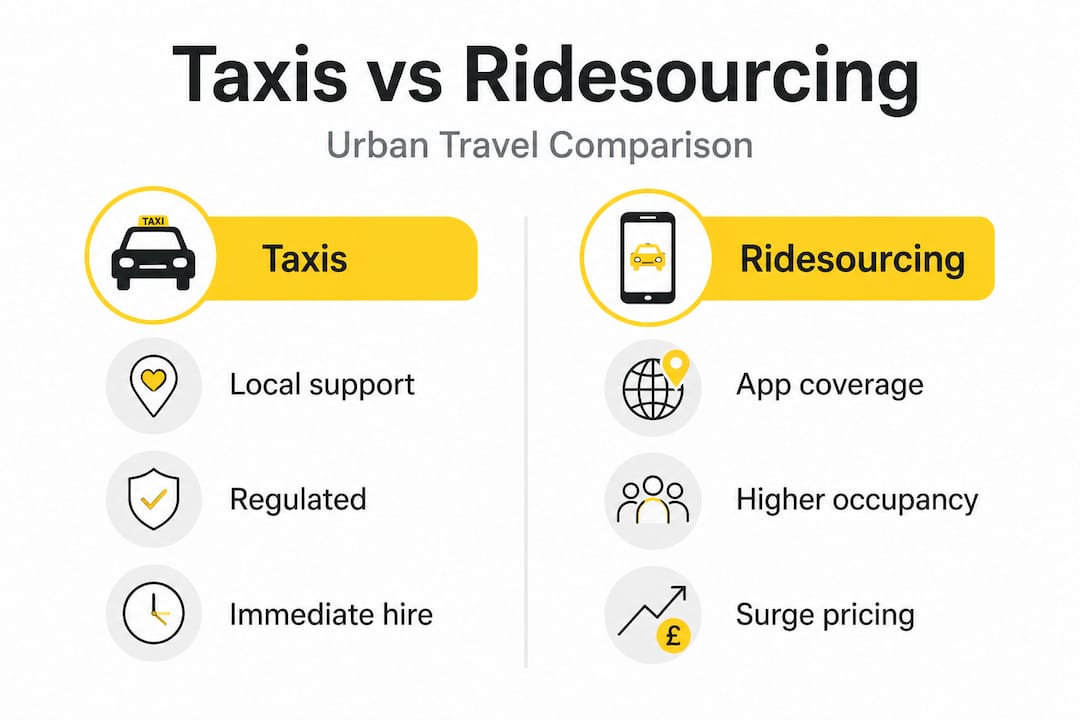
So when does a traditional taxi still win? Here is a direct comparison:
| Scenario | Best choice | Reason |
|---|---|---|
| Late-night airport arrival | Traditional taxi | Reliable, waiting, no app needed |
| Pre-planned suburban trip | Ridesourcing app | Wider coverage, advance booking |
| City-centre short journey | Traditional taxi | Immediate hire, no surge pricing |
| Healthcare or formal travel | Ridesourcing or taxi | Depends on local availability |
| Tourist first night in a new city | Traditional taxi | Fixed pricing, regulated driver |
| Off-peak commute from familiar area | Ridesourcing app | Better efficiency and coverage |
When choosing between the two, consider these factors in order:
- Urgency. If you need a ride right now, a taxi rank delivers without app delays or cancellations.
- Location. In city centres, taxis are abundant. In outer suburbs, apps often have better coverage.
- Price certainty. Fixed-rate taxis eliminate the anxiety of surge pricing during busy periods.
- Accountability. Licensed taxis operate under local regulations, providing a clear complaints process if something goes wrong.
- Local economy. Where your fare goes matters if you care about community impact.
“The best transport option is not always the cheapest one. It is the one that reliably gets you where you need to be, when you need to be there.”
For tourists especially, choosing the best urban transport involves weighing convenience, safety, and cost together rather than chasing the lowest single fare.
How to choose and get the best from urban taxis
Making the most of taxi travel starts before you even reach the kerb. A little preparation turns a stressful, unknown journey into a smooth, predictable experience, and that matters most when you are travelling somewhere unfamiliar.
For tourists, taxi fleets offer reliable airport transfers with fixed pricing and meet-and-greet services, with cities like London and Athens providing strong examples. For locals, the 24/7 availability is the core appeal, though increased competition in some markets has added pressure on fleet efficiency.
Here is how to make your taxi journeys work for you:
- Book in advance for airport transfers. Pre-booked taxis guarantee a driver is waiting, removing the stress of queuing or app-hunting after a long flight.
- Confirm pricing before you travel. Reputable services publish fixed rates for key routes. Always ask for clarification if the fare structure is unclear.
- Check driver credentials. Licensed drivers carry ID and operate under regulated standards. Do not accept unlicensed rides, especially late at night.
- Use the official taxi rank or a verified booking platform. Unofficial touts near airports and tourist hotspots are a well-known scam across many cities.
- Share journey details with someone you trust. Before a late-night or solo ride, send your booking confirmation and estimated arrival time to a contact.
- Request a receipt. For business travel or insurance purposes, always request a fare receipt. Most professional services issue these as standard.
Pro Tip: If you are visiting a new destination and unsure which taxi company to trust, look for services that offer transparent online booking with confirmed prices. The ability to see your driver details and track your vehicle in real time is a strong indicator of a professional, accountable service.
Reviewing airport taxi safety advice before you fly helps you arrive prepared rather than vulnerable. And understanding the broader stress-free travel benefits of a well-chosen taxi service is about more than comfort. It is about arriving at your destination in the right state of mind for whatever comes next.
Why taxi fleets remain crucial in a tech-driven urban world
Here is an uncomfortable truth that the ride-hailing industry rarely advertises: most of the money you spend on a gig-economy ride leaves your city almost immediately. Platform commissions of up to 40% flow directly to corporate headquarters, often overseas, while drivers absorb fuel, insurance, and vehicle costs from the remainder.
Traditional taxis retain between 60% and 70% of fare revenue within the local economy, compared to ride-share models that extract far greater proportions through corporate commissions. Ridesourcing platforms do achieve higher vehicle occupancy and utilisation rates, which is a genuine operational advantage, but that efficiency comes at a real community cost that rarely features in the conversation about transport choices.
Beyond economics, there is the matter of contextual reliability. Algorithms are excellent at optimising across thousands of journeys simultaneously, but they struggle with the specific, local knowledge that experienced taxi drivers carry. Knowing the back route around a flooded underpass, understanding which terminal is actually closest to departures, recognising a passenger who needs extra time to board; these are human judgements that technology has not replaced.
The gig economy model also creates fragility. During peak demand, both pricing and availability become unpredictable. Surge pricing can triple a fare in minutes. Drivers log off during rain or public holidays precisely when demand spikes. A regulated taxi fleet, by contrast, is obligated to maintain service levels as part of its licensing conditions.
We believe the smartest travellers do not default to whichever app is open on their phone. They make deliberate choices based on where they are, what they need, and what kind of service they want to support. Exploring technology in local taxi services shows how modern taxi companies are closing the gap on digital convenience while preserving the reliability and local accountability that gig platforms cannot replicate.
Taxi fleets are adapting. Electric vehicles, app-based booking, real-time tracking, and transparent pricing are features that forward-thinking taxi operators already offer. The distinction between a taxi and a ride-hailing app is shrinking on the technology front, but it remains wide on the accountability, community value, and reliability fronts.
Book reliable airport and city taxis for your next journey
Whether you are arriving at Larnaca airport for the first time or planning a series of city journeys across Cyprus, choosing the right transport makes every difference to how your trip unfolds.

At Taxi in Larnaca, we offer fixed-rate transfers, experienced local drivers, and a modern fleet built for comfort, safety, and punctuality. From solo travellers to families and corporate clients, every booking is handled with care. Explore your airport taxi vehicle choices to find the right vehicle for your group size and journey type. When you are ready to plan your arrival, our reliable Larnaca airport transfers guide walks you through every step of the booking process so nothing is left to chance.
Frequently asked questions
How do taxi fleets improve urban mobility for tourists?
Taxi fleets offer door-to-door convenience, fixed pricing, and airport transfer reliability, making city navigation simple for visitors. Flexible, convenient service is essential for urban mobility, particularly for those unfamiliar with local transport networks.
Are electric taxis widely available in cities?
Many urban taxi fleets are actively introducing electric vehicles, supported by depot and home charging infrastructure. Electrification is viable and improves air quality by eliminating tailpipe particulate matter, even in areas where the electricity grid is not fully renewable.
What is the main difference between taxis and ridesourcing apps?
Taxis offer immediate hire, local economic support, and regulated accountability, while ridesourcing apps provide higher trip volumes and broader suburban coverage. Ride-hailing services double trip volume compared to traditional taxis and reach more passengers outside city centres.
Are taxis a good option for airport transfers compared to other modes?
Taxis are especially valued for airport journeys because of fixed rates, meet-and-greet services, and the absence of surge pricing. Reliable airport transfers with confirmed pricing give tourists genuine peace of mind after a long journey.