

Essential safety tips for airport taxis in Larnaca
Essential safety tips for airport taxis in Larnaca
TL;DR:
- Always use official taxi ranks and look for licensed driver identification.
- Pre-book transfers to ensure safety, fixed fares, and reliable service.
- Conduct quick safety checks and confirm fare details before starting your journey.
Arriving at Larnaca International Airport after a long flight, the last thing you want is to fall victim to an unlicensed driver or an inflated fare. Cyprus attracts millions of visitors each year, and unfortunately, opportunistic taxi touts know exactly how to spot a tired, unfamiliar traveller. The Australian Government’s Smartraveller advice is clear: use official taxi ranks and authorised services to avoid unlicensed operators. Getting this one decision right sets the tone for your entire stay. This guide walks you through five practical, expert-backed steps to ensure your airport transfer in Larnaca is safe, fair, and stress-free from the moment you land.
Table of Contents
- Always choose official airport taxis
- Confirm fares and avoid overcharging
- Pre-book transfers for extra security
- Essential safety checks before your journey
- Why pre-booking and vigilance matter more than ever
- Book a safe and reliable Larnaca airport transfer
- Frequently asked questions
Key Takeaways
| Point | Details |
|---|---|
| Only use official taxis | Stick to licensed vehicles from designated airport ranks to avoid scams and safety risks. |
| Confirm fares up front | Always agree the fare or check the taximeter to avoid unexpected charges. |
| Pre-book for extra peace of mind | Booking in advance ensures a vetted driver, fixed price, and a safe journey—especially for families or late arrivals. |
| Check credentials and safety gear | Verify documents, number plate, and car seat for children before setting off. |
Always choose official airport taxis
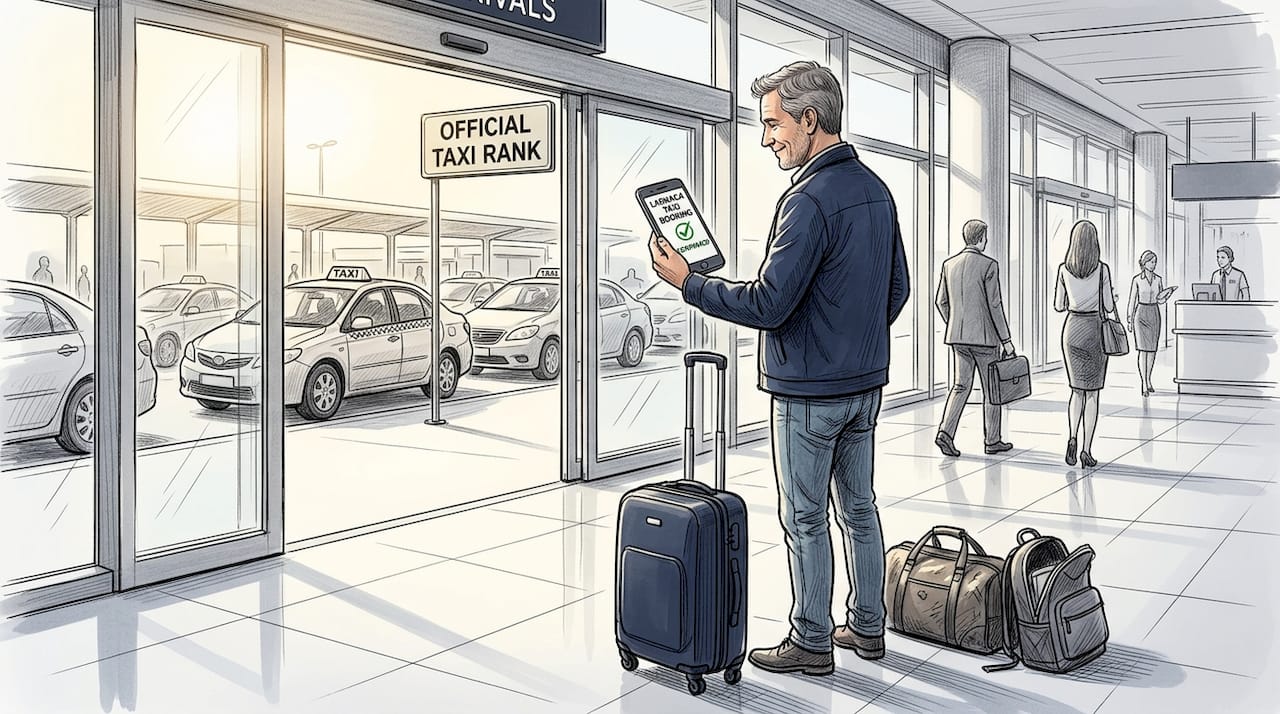
Establishing where to find safe, official taxis sets the foundation for a stress-free journey. The most important rule when leaving Larnaca Airport is simple: go straight to the designated taxi rank. Do not engage with anyone who approaches you inside the terminal building offering a ride. Official taxi ranks are positioned directly outside the arrivals hall, clearly marked with signage, and staffed by licenced drivers who operate under regulated conditions.
So how do you spot a legitimate taxi? Here are the key markers to look for:
- Visible taxi licence plate displayed on the vehicle, typically yellow or clearly marked
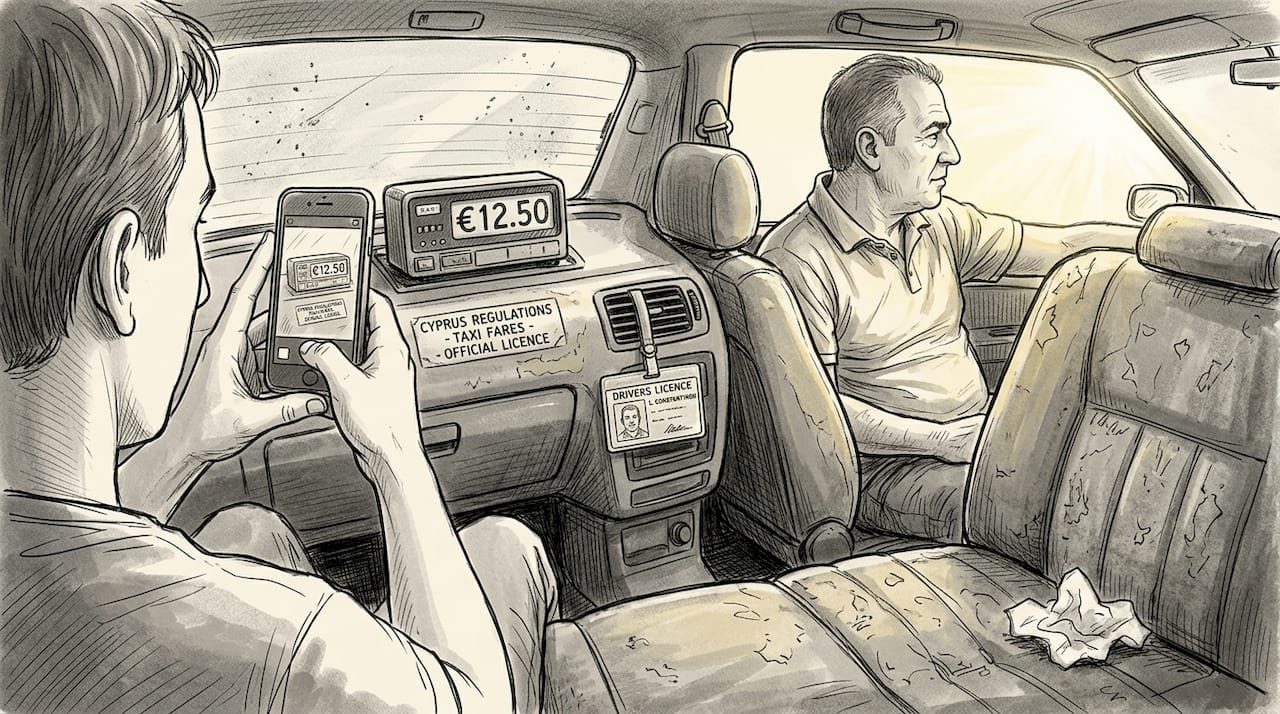
- Driver ID card mounted inside the vehicle where passengers can read it
- Official vehicle markings including a roof sign and regulated colour scheme
- Inspection stickers on the windscreen confirming the vehicle has passed safety checks
- Taximeter fitted and operational before the journey begins
Drivers who approach you inside the terminal, offer suspiciously low prices, or refuse to show identification are almost certainly operating without a licence. The risk is not just financial. Unvetted drivers pose genuine personal safety concerns, particularly for solo travellers or those arriving late at night.
“Official taxi ranks and services are located directly outside arrivals; avoid aggressive approaches inside the terminal.” Airport pickups guide
For added confidence, you can arrange reliable Larnaca taxi bookings in advance, so a vetted driver is already waiting for you with a name board when you exit. This removes any ambiguity and eliminates the need to make decisions while tired and unfamiliar with the surroundings.
Pro Tip: Before you get into any taxi at the airport, photograph the licence plate and driver ID. Send it to a trusted contact. This takes thirty seconds and significantly increases your personal security.
Checking government travel advice before your trip also gives you an up-to-date picture of any specific risks or changes in local transport regulations.
Confirm fares and avoid overcharging
Knowing you have picked an official airport taxi, the next step is ensuring you pay a fair rate. Taxi overcharging is one of the most commonly reported travel complaints in Cyprus, and Larnaca Airport is a known hotspot. City centre fares typically range from €15 to €20 for standard routes, yet recent overcharging cases have documented passengers paying between €200 and €300 for the same journey with unlicensed operators.
The contrast is stark. Here is a comparison of typical official fares versus reported scam fares:
| Route | Official fare | Reported scam fare |
|---|---|---|
| Airport to Larnaca city centre | €15 to €20 | €80 to €150 |
| Airport to Limassol | €55 to €70 | €150 to €300 |
| Airport to Ayia Napa | €40 to €55 | €100 to €200 |
| Airport to Nicosia | €45 to €60 | €120 to €250 |
Even with licenced drivers, night surcharges apply after midnight, so your fare will legitimately be higher during those hours. The key is knowing this in advance rather than being surprised at the destination.
Here is what to do to protect yourself:
- Ask for a fare estimate before the journey begins
- Confirm the taximeter is running from the moment you depart
- Check the official tariff card, which licenced drivers are required to carry
- Avoid paying cash upfront in full before reaching your destination
- Cross-reference with Cyprus taxi standards if you are unsure
Reforms to enforce pricing rules are ongoing, but the burden of vigilance still falls on the traveller in the short term.
Pro Tip: Screenshot the agreed fare or take a photo of the taximeter reading at the start of your journey. This gives you a clear reference point if any dispute arises on arrival.
Pre-book transfers for extra security
Beyond hailing at the terminal, consider why pre-arranging your ride can outshine walk-up options. Pre-booking an airport transfer is not just a convenience. It is a measurable safety upgrade. Pre-booking saves up to 20% compared to on-demand taxis and ensures your driver is vetted, licenced, and tracking your flight in real time.
Here is how pre-booked transfers compare to on-the-spot options:
| Factor | Pre-booked transfer | On-the-spot taxi |
|---|---|---|
| Driver vetting | Full background check | Unknown |
| Fare certainty | Fixed price agreed | Variable, risk of overcharging |
| Flight monitoring | Yes, adjusts for delays | No |
| Wait time | Driver meets you on arrival | Queue or search required |
| Cancellation policy | Clear terms | None |
The advantages are particularly significant for families travelling with children, groups with large luggage, or anyone arriving on a late-night flight. A pre-booked service removes the guesswork entirely.
Following this step-by-step booking guide makes the process straightforward:
- Visit the taxi provider’s website and enter your flight details
- Select a vehicle type suited to your group size and luggage
- Confirm the fixed fare and read the cancellation policy
- Receive a booking confirmation with driver contact details
- On arrival, follow the instructions to meet your driver at the agreed point
Experts in private transfer advantages consistently highlight that pre-booked services reduce stress, eliminate negotiation, and provide accountability that walk-up taxis simply cannot match.
Statistic: Travellers who pre-book airport transfers save up to 20% on fares and report significantly higher satisfaction with their transfer experience compared to those who hail taxis on arrival.
Essential safety checks before your journey
Once your taxi is booked, a minute of safety checks can complete your peace of mind. Whether you have pre-booked or selected an official rank taxi, a few quick checks before you set off can make a real difference.
Licensed taxis display ID and inspection stickers, and drivers are required to have passed background checks. Here is your pre-departure checklist:
- Verify the driver’s ID card is visible and matches the booking confirmation
- Check the number plate matches any details you received at booking
- Photograph the vehicle and send it to a contact before departing
- Test the seatbelt before the car moves
- Confirm the taximeter is set to zero and running
- Note the taxi company name displayed on the vehicle
For families, this step is especially important. Cyprus law requires car seats for children under five years of age, and proper child restraints can reduce injury rates by up to 80% in the event of an accident. Most standard taxis do not carry car seats by default, so you must request one explicitly when booking.
Statistic: Using an approved child car seat reduces the risk of injury in a road accident by up to 80%, making advance requests non-negotiable for families with young children.
For guidance on how to ride securely in Cyprus, a little preparation goes a long way. The entire check process takes under two minutes but provides a significant layer of protection.
Pro Tip: Ask to see the driver’s interior ID card, not just the licence plate. The plate tells you the vehicle is registered; the ID card tells you the person driving it is authorised.
Why pre-booking and vigilance matter more than ever
Bringing these tips together, it is worth considering why expert advice prioritises proactive steps even as Larnaca modernises its taxi system. The 2026 reforms introduced stricter standards, mandatory digital fare enforcement, and new anti-piracy measures. These are genuine improvements, and they matter. But reforms take time to embed across an entire industry, and not every operator complies immediately.
In our experience, the travellers who encounter problems are rarely those who were unlucky. They are usually those who assumed the system would protect them automatically. Scams and overcharging incidents do not disappear overnight simply because new rules exist. The safest mindset is to treat every transfer as if it is your first, even if you have visited Larnaca dozens of times.
Pre-booking is the single most effective step you can take. It removes the moment of vulnerability at the arrivals hall entirely. Pairing that with the quick safety checks described above means you are never relying on luck or goodwill. To enhance travel reliability, set a reminder before every trip to review current standards. What applied last year may have changed.
Pro Tip: Treat every transfer as new. Never assume past experience guarantees current safety. A quick two-minute check is always worth it.
Book a safe and reliable Larnaca airport transfer
If these tips have made one thing clear, it is that the safest airport transfer is one you have already arranged before you land.

At Taxi in Larnaca, we offer fully licenced, pre-bookable airport transfers with fixed fares, flight tracking, and professional drivers who carry visible ID. Whether you are travelling solo, with family, or as part of a corporate group, you can see vehicle options suited to every need. No queues, no negotiation, no surprises. Simply arrange your transfer online before your trip and arrive knowing everything is already taken care of. It is the smartest step any traveller can take.
Frequently asked questions
How do I identify an official taxi at Larnaca Airport?
Official taxis use designated ranks outside the arrivals hall, display a visible driver ID card and vehicle licence, and will never approach you aggressively inside the terminal building. Always check credentials before boarding.
What should I do if I suspect my taxi fare is too high?
Confirm the fare before your journey starts, ensure the taximeter is running from the outset, and compare against official rate charts. Reports of overcharging reaching €200 or more highlight why you should never pay a large sum upfront without agreeing the price first.
Are car seats provided for airport taxi rides in Larnaca?
Car seats are required by Cyprus law for children under five, but most taxis lack them by default. You must request a car seat explicitly when making your booking to guarantee one is available.
Is it safe to take a taxi at night from Larnaca Airport?
Yes, provided you use a licenced taxi from the official rank or a pre-booked service. Night fares are legitimately higher, but beware overcharging by unlicensed operators who are more active after dark. Always confirm the fare before departing.
How do reforms in 2026 affect taxi safety in Larnaca?
2026 reforms mandate digital taximeters, card payment acceptance, and stricter anti-piracy measures across the industry, improving accountability and making it easier to identify and report non-compliant operators.