

Why online reviews help you choose the best taxi

Why online reviews help you choose the best taxi
TL;DR:
- Passenger reviews now heavily influence trust, visibility, and booking decisions for taxi services in Larnaca. High-quality, recent, and specific feedback pressures providers to improve, creating a positive cycle of service enhancement. Reading diverse, detailed reviews across platforms helps travelers identify reliable taxis and avoid manipulated or misleading ratings.
Choosing a taxi in Larnaca used to rely almost entirely on word of mouth. A friend’s recommendation, a hotel concierge’s suggestion, or simply the first cab you spotted outside arrivals. Today, that process looks completely different. Passenger reviews now shape customer trust, booking intent, and even which services appear at all when you search for a ride. Understanding how this system works means you can make sharper, safer decisions every time you need transport in Cyprus.
Table of Contents
- How reviews shape trust and first impressions
- Why reviews push Larnaca taxi services to improve
- How reviews influence which taxis you actually see online
- Tips for reading reviews wisely and spotting reliability
- The reality most people miss about reviews and taxi services
- Find the most trusted Larnaca taxi for your journey
- Frequently asked questions
Key Takeaways
| Point | Details |
|---|---|
| Trust-building | Recent, positive reviews instantly signal reliability to Larnaca travellers and locals looking for a taxi. |
| Quality control | Customer ratings push taxi providers to maintain and improve their service standards. |
| Search visibility | Taxi services with more and better reviews are much more likely to appear in map and search results. |
| Smart review reading | Cross-referencing multiple review sources helps avoid bias, fraud, and poor choices. |
How reviews shape trust and first impressions
Having set the stakes, let’s break down how reviews actually transform the decision process from the moment you start searching.
When you type “taxi Larnaca” into Google Maps, you see a list within seconds. What you probably don’t notice is that you’re not just seeing a list of local businesses. You’re seeing a ranked, filtered view shaped largely by what other passengers have said. Reviews act as social proof, a concept where people rely on others’ experiences to judge quality when they can’t verify it themselves. In transport, where safety and punctuality genuinely matter, that social proof carries serious weight.
Most travellers and locals now check feedback before they ever contact a taxi company. According to findings on how passenger reviews influence demand, online ratings directly affect customer trust, booking intent, and overall visibility when people compare nearby services. That means a taxi firm with a 4.8-star rating and 300 reviews will almost always get the call before one with a 3.9 and 40 reviews, even if their prices are identical.
Consider what a first impression looks like in practice. You see a listing. You notice the star rating. You skim the top three reviews. Within about 20 seconds, you’ve formed an opinion that is very difficult to reverse. This process is almost automatic. Strong, recent feedback signals that a provider is reliable, consistent, and worth your time. Vague or negative feedback raises red flags immediately, even if the issues described were isolated incidents.
Here’s what review signals typically communicate at a glance:
- Star rating: Passengers interpret anything below 4.0 as a warning sign, even if the underlying reasons vary widely
- Volume of reviews: More reviews suggest more experience and a track record, not just a lucky streak
- Recency: Reviews from the past three to six months carry the most weight for predicting current quality
- Specificity: Reviewers who mention punctuality, vehicle cleanliness, and driver courtesy are more credible than vague praise
- Provider responses: A company that replies thoughtfully to criticism signals professionalism and accountability
“Before a passenger even clicks through to a company’s website, their mind is often already made up based on the review profile they’ve just scanned. The data doesn’t lie: ratings drive bookings.”
Understanding travel choices and trust is central to picking the right taxi service. Research into experienced drivers and safe transport consistently shows that passengers prioritise trust signals above price when safety is on the line. When you understand what reviews actually communicate, you stop seeing them as optional background reading and start treating them as essential information. Knowing the features of reliable fleets also helps you verify whether a company’s review claims match what they actually offer.
Why reviews push Larnaca taxi services to improve
Trust isn’t just about attracting bookings. Reviews drive providers to raise their game as well. Here’s how.
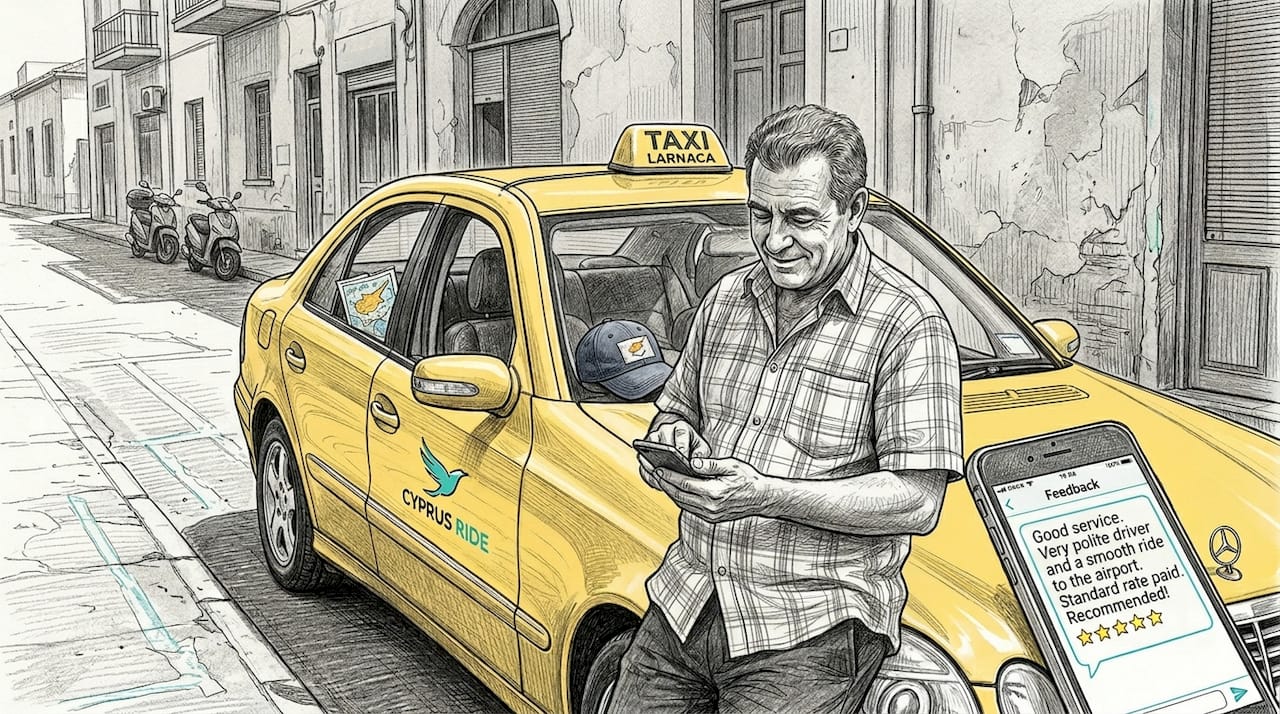
There is a powerful, often overlooked dynamic at play in Larnaca’s taxi market. Reviews don’t just inform customers. They change the behaviour of service providers. When a driver receives a poor rating or a detailed negative review, that signal goes directly back into the system. For conscientious operators, it triggers a response: retraining, a conversation with the driver, or a change in how bookings are managed.
Reputation mechanisms in ride-hailing such as driver ratings have been studied extensively and consistently shown to act as quality-control tools. When providers know each journey can generate a public rating, they have a real and ongoing incentive to perform well. The consequence is a market where poor-quality operators face growing pressure to improve or lose business entirely.
It also matters how patterns emerge across multiple reviews. A single one-star review might represent an unusual situation, a traffic jam, a miscommunication. But five one-star reviews in two months, all mentioning late arrivals, tell a very different story. Review systems in service industries can reduce information gaps between customers and providers and pressure low-quality operators to upgrade their standards or step back.
| Service quality issue | Typical review signal | Likely provider response |
|---|---|---|
| Frequent lateness | Repeated mention of delays | Operational review, scheduling changes |
| Unprofessional drivers | Comments on rudeness or poor communication | Driver briefing or retraining |
| Dirty vehicles | Specific mentions of cleanliness | Fleet maintenance checks introduced |
| Pricing confusion | Complaints about unexpected charges | Clearer pricing policies published |
| Cancellations at short notice | Patterns across multiple reviews | Booking confirmation process updated |
This feedback loop benefits you directly. The more passengers leave honest, specific reviews, the more what matters for quality becomes the real competition between Larnaca taxi providers. Price becomes secondary. Experience becomes the currency.
Pro Tip: When you leave a review, mention specific details such as whether the driver arrived on time, whether the vehicle was comfortable, and whether communication was clear. Specific feedback is what drives real change, not just a star rating.
How reviews influence which taxis you actually see online
But reading reviews does more than boost trust and quality. It affects the digital landscape of what you see when searching for a ride.
This is where things get genuinely surprising for most people. You may think you’re seeing a neutral list of taxi services when you search on Google Maps. You’re not. The order of results, the prominence of certain listings, and even whether a business appears at all are all influenced by review signals. Review signals affect local map visibility directly, shaping both relevance and prominence in ways that are invisible to most users but very real in their effect.
Google’s local ranking algorithm weighs several review-related factors. These include the overall star rating, the volume of reviews, the recency of reviews, and even whether the business owner responds to feedback. A taxi service that actively manages its online reputation, replying to reviews, thanking satisfied customers, and addressing complaints professionally, tends to rank noticeably higher than one that ignores this entirely.
| Ranking factor | Low-performing service | High-performing service |
|---|---|---|
| Star rating | 3.2 average | 4.7 average |
| Total reviews | 12 reviews | 340 reviews |
| Review recency | Last review 8 months ago | Last review 3 days ago |
| Owner responses | None | Responds to 90% of reviews |
| Keyword mentions in reviews | Rare | Frequent (“punctual”, “clean”, “airport”) |
The practical consequence of this is that a well-reviewed Larnaca taxi company becomes more visible simply because it’s well-reviewed. It’s a reinforcing loop. More visibility means more bookings. More bookings mean more reviews. More reviews mean higher rankings. Understanding how technology shapes taxi visibility in Larnaca gives you the context to see why some services dominate results while equally capable providers remain buried on page two.
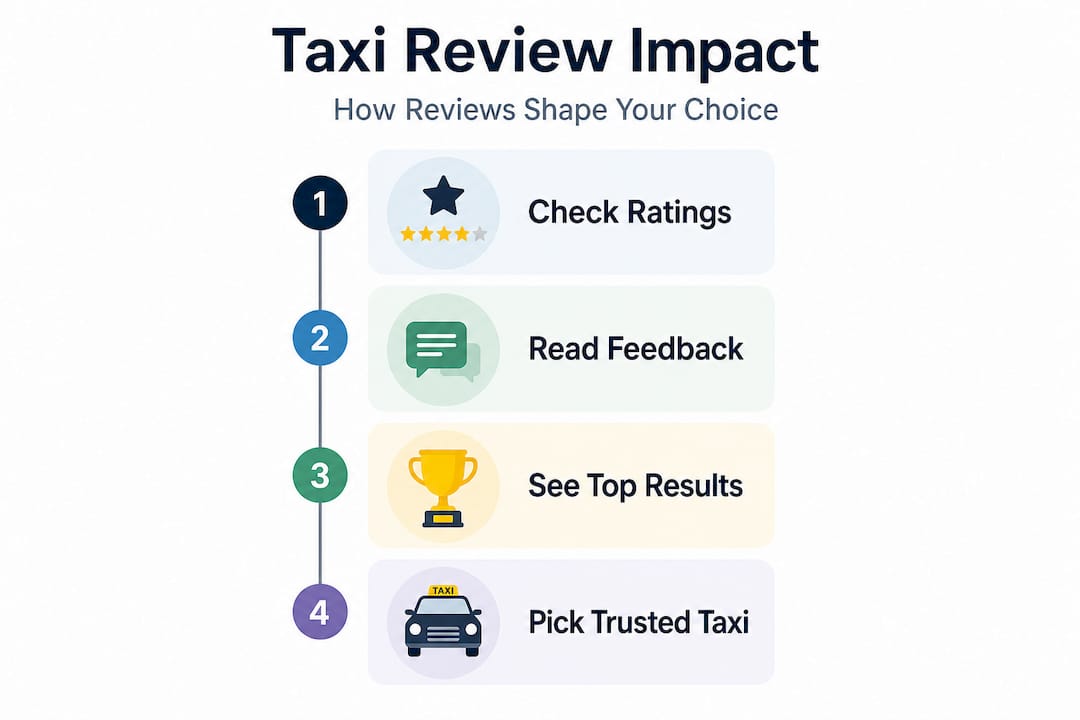
It’s also worth knowing that major review platforms each have their own ranking logic. What pushes a business to the top on Google Maps may differ from what makes a listing prominent on Tripadvisor. This is exactly why relying on a single platform can give you an incomplete or distorted picture.
Tips for reading reviews wisely and spotting reliability
Because not all reviews are created equal, let’s end with practical steps to make your decisions sharper and safer.
Reading reviews sounds straightforward. In reality, it requires a degree of critical thinking that most people skip in the rush to book. The first rule is to cross-reference. Don’t rely on a single platform. Check Google, Tripadvisor, and Trustpilot. If a taxi service consistently scores well across all three, that’s a genuinely strong signal. If it shines on one and performs poorly on another, that inconsistency is worth investigating.
Be cautious of extremes at both ends. A service with only five-star reviews and a small total number of ratings is actually less trustworthy than one with 200 reviews averaging 4.3. Perfect scores from a tiny sample often indicate either cherry-picked feedback or coordinated posting. Review fraud and selection bias are real risks in any service industry, and taxi services are no exception. Small numbers of suspiciously uniform reviews are a red flag.
Here is a practical step-by-step approach to reading taxi reviews effectively:
- Start with volume. Look for services with at least 50 reviews before taking ratings seriously.
- Filter by recency. Sort by newest first and read the last 10 to 15 reviews before anything else.
- Look for specificity. Reviews that mention punctuality, driver name, vehicle type, or route details are far more credible than generic praise.
- Check operator responses. A company that replies to both praise and criticism shows genuine engagement and professional accountability.
- Read the one and two-star reviews carefully. Understand whether the complaints describe isolated incidents or patterns across multiple customers.
- Cross-check platforms. Compare scores on Google, Tripadvisor, and Trustpilot before committing to a booking.
- Spot the outliers. A cluster of negative reviews posted within a short period, or a sudden spike in five-star ratings, warrants scepticism.
Pro Tip: When reading negative reviews, pay attention to how the company responded rather than just what went wrong. A thoughtful, professional reply to criticism tells you far more about a company’s character than the original complaint does.
When it comes to picking reliable taxis in Larnaca, applying this kind of structured review-reading can save you from real problems. A missed airport transfer or an unpleasant journey isn’t just inconvenient. It can derail an entire trip.
The reality most people miss about reviews and taxi services
Having navigated how to read reviews wisely, here’s a candid reflection: most people fundamentally misunderstand what makes online reviews in transport so powerful and so risky at the same time.
Most travellers treat reviews as a consumer tool. Something you glance at before booking, then forget. But reviews in the taxi industry function as something much more significant. They are a live feedback system that actively reshapes the behaviour of every provider in the market. This is not a minor distinction.
Reputation systems actively change provider incentives and behaviour, functioning effectively as a quality-control layer that improves outcomes when low ratings serve as warnings. In plain terms, the review you leave after a journey doesn’t just inform the next passenger. It can directly change how the driver behaves on their next booking, how a company trains its staff, and whether a poorly performing operator stays in business at all.
The risk sits on the other side of this equation. Because reviews carry so much power, they are also vulnerable to manipulation. A competitor can generate negative reviews. A company can encourage loyal customers to post five-star ratings in bulk. The system can be gamed, and when it is, it misleads the very passengers it was built to serve.
What this means in practice is that the critical mass of reviews matters enormously. A handful of reviews, however positive, doesn’t prove quality. Consistent, specific, recent feedback across multiple platforms does. And that kind of genuine review profile is genuinely hard to fake at scale. This is why we always encourage passengers to look at the fleet reliability features of any provider alongside their review profile, because real-world evidence and digital reputation should align.
The taxi services worth trusting in Larnaca are those whose reviews reflect the same values visible in how they operate: clean vehicles, professional drivers, transparent pricing, and consistent punctuality. When reviews and reality match, you can book with real confidence.
Find the most trusted Larnaca taxi for your journey
Now that you understand the real impact of reviews, here’s how to apply what you’ve learned.
You’ve seen how reviews shape trust, drive quality improvements, and determine which services you even find online. The next step is putting that knowledge to practical use.

At Taxi in Larnaca, we take our review profile seriously because we know what it represents: real passenger experiences, not marketing language. Our fleet is modern, our drivers are professional, and our commitment to punctuality is something you’ll see reflected across every platform where customers share feedback. Whether you need best Larnaca taxi services for a group transfer or seamless reliable airport transfers, we make it straightforward to book and easy to trust. Apply what you’ve read here: check the reviews, read the responses, and see for yourself why consistent passengers choose us for every journey.
Frequently asked questions
Do reviews really affect which taxi shows up in Google Maps?
Yes. Review signals shape local map visibility directly, influencing both relevance and prominence so that well-reviewed services appear first in results.
Is it better to trust Google, Tripadvisor, or another platform for taxi reviews?
Cross-checking across multiple platforms is always more reliable. Review fraud and selection bias mean that relying on a single source can give a misleading picture of actual service quality.
Can negative reviews actually make a taxi company improve?
Yes. Reputation mechanisms in ride-hailing function as quality-control tools, and providers regularly adjust their behaviour, retrain staff, or revise processes in direct response to poor ratings.
How many reviews are enough to be trustworthy?
A higher volume of specific, recent reviews spread across more than one platform is the strongest signal of genuine quality. A business with only a handful of reviews cannot reliably demonstrate consistent service, however positive those few reviews appear.