

How to choose a safe taxi in Larnaca: A practical guide
How to choose a safe taxi in Larnaca: A practical guide
TL;DR:
- Unlicensed taxis in Larnaca often lack insurance, clear branding, and proper documentation, posing safety risks.
- Pre-booked licensed taxis with visible identification, meters, and receipts are the safest travel options.
- Verify your taxi’s registration, driver ID, and fare details before and during the journey to ensure safety.
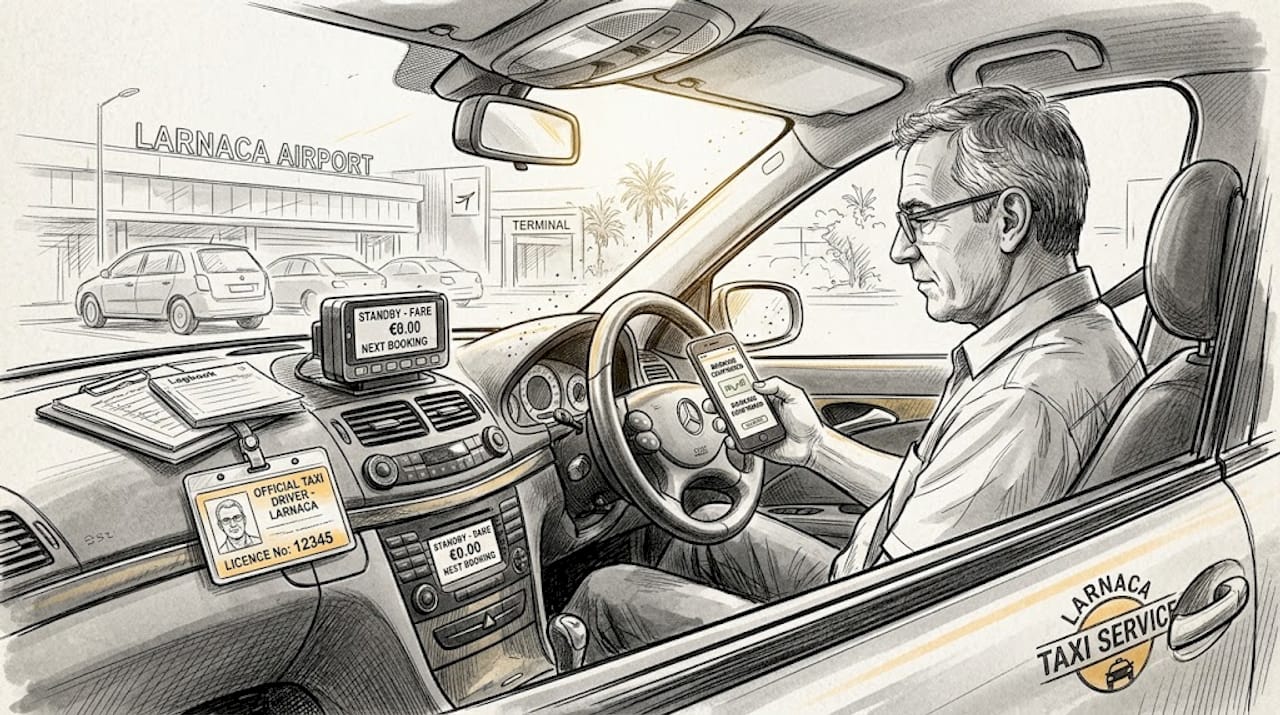
Arriving in Larnaca after a long flight, bags in hand, you scan the crowd outside arrivals for a taxi. Several drivers wave you over, promising fixed fares and fast rides. But which one is legitimate? Pirate taxis are common in tourist areas including Larnaca Airport, with unlicensed operators routinely overcharging passengers and operating without insurance. The good news is that safety is absolutely achievable if you know what to look for. This guide walks you through every step, from understanding the risks to verifying your driver on the road, so you can travel with complete confidence.
Table of Contents
- Understanding the risks: Why taxi safety matters in Larnaca
- Preparation checklist: What to know before booking a taxi
- Step-by-step guide: Booking and verifying your taxi in Larnaca
- Ensuring your journey stays safe: On the road precautions
- A local perspective: What most travellers get wrong about taxi safety in Larnaca
- Reliable taxi options for your Larnaca journey
- Frequently asked questions
Key Takeaways
| Point | Details |
|---|---|
| Look for licensed taxis | Only use clearly marked, government-registered taxis with visible IDs and a working meter. |
| Pre-book for safety | Booking through reputable apps or official providers adds a crucial layer of protection and transparency. |
| Follow a safety checklist | Confirm licence details, note the number plate, and always request a receipt at journey’s end. |
| Stay alert on the road | Check seat belts, share your journey with someone, and don’t hesitate to exit if something feels wrong. |
Understanding the risks: Why taxi safety matters in Larnaca
Most travellers land in Larnaca and assume any car with a taxi sign is safe to board. That assumption can be costly, and occasionally dangerous. The reality of unlicensed, or “pirate,” taxis in Cyprus is well documented, and understanding the specific risks they pose is the first step towards protecting yourself.
Pirate taxis operate outside the regulatory framework entirely. They carry no commercial insurance, meaning that if you are injured in an accident, you may have no legal recourse for compensation. They charge whatever price they choose, often targeting tourists who are unfamiliar with standard fares. Disputes are difficult to resolve because there is no paper trail, no metre reading, and no company to complain to. The driver may vanish the moment you step out of the vehicle.
“Pirate taxis are particularly prevalent near airports and tourist hotspots, with overcharging and lack of insurance being the most common complaints. Ongoing regulatory reforms targeting illegal operators include mandatory metres, driver training requirements, and significant fines for non-compliance.”
Cyprus is actively addressing these problems. Reforms currently in progress include mandatory metre installation across all licensed taxis, formal training standards for drivers, and substantial financial penalties for operators caught working illegally. These are meaningful steps forward, but enforcement takes time. Until the reformed system is fully operational, passengers need to rely on their own checks.
Official advice from authorised government sources is consistent: only board taxis that are authorised by the Road Transport Department, and always confirm that the metre is switched on at the start of your journey. A licensed taxi will be clearly marked, will carry a printed licence, and will not offer a vague verbal quote as a replacement for a legitimate metered fare.
Familiarising yourself with taxi safety standards in Cyprus before you arrive saves significant stress when you land. Equally, understanding the broader industry standards for taxi safety in the region helps you recognise when something feels off.
Common problems reported with unlicensed taxis in Larnaca:
- No commercial insurance, leaving passengers unprotected in accidents
- Inflated fares with no metre and no receipt provided
- No driver identification displayed inside or outside the vehicle
- Refusal to provide contact details or company information
- No record of the journey, making disputes impossible to resolve
- Vehicles in poor mechanical condition, posing additional safety risks
| Risk factor | With a pirate taxi | With a licensed taxi |
|---|---|---|
| Insurance coverage | None | Full commercial insurance |
| Fare transparency | Verbal quote only | Metre required by law |
| Driver accountability | No regulation | Licensed and registered |
| Dispute resolution | No mechanism | Official complaints process |
| Vehicle standards | Unregulated | Regular inspections required |
Arriving informed is your strongest defence. These risks are real, but every single one of them is avoidable with the right preparation.
Preparation checklist: What to know before booking a taxi
Good taxi safety begins before you even land. A few simple steps taken during your travel planning phase can eliminate the most common risks entirely and leave you with a straightforward, stress-free arrival in Larnaca.
Start by researching the regulatory landscape. The Road Transport Department of Cyprus oversees all licensed operators, and the 2026 reforms add a digital licence verification platform that will eventually allow passengers to check a driver’s credentials instantly via their smartphone. While that system is still being rolled out, using established booking platforms or vetted local taxi services is the most reliable alternative available to you right now.
Comparison between authorised and unauthorised taxis:
| Feature | Authorised taxi | Unauthorised taxi |
|---|---|---|
| Visible company branding | Always present | Rarely or never |
| Licensed metre installed | Yes, mandatory | No, or disconnected |
| Driver ID displayed | Legally required | Absent |
| Receipt available on request | Standard practice | Often refused |
| Child seats available on request | Can be arranged | Unpredictable |
| Pre-booking possible | Yes, via apps or phone | No formal system |
Preparation checklist for booking a safe taxi in Larnaca:
- Research licensed taxi services or apps before departing for Cyprus
- Pre-book your airport transfer through a verified platform or direct with a licensed firm
- Screenshot your booking confirmation, including the vehicle registration number
- Note the driver’s name and the estimated arrival time provided at booking
- Save the company’s contact number separately in case of communication issues
- Request a child seat in advance if travelling with young children
- Confirm that the service operates with metered fares or a pre-agreed fixed price
- Check essential airport taxi safety tips specific to Larnaca arrivals
Pro Tip: When booking a reliable taxi through an app or website, always choose services that display the driver’s photo, full name, and vehicle registration before the car arrives. This allows you to verify identity at a glance before you even open the door.
Pre-booking is particularly valuable for late-night arrivals, solo travellers, and families with children. You have a confirmed driver, a record of the booking, and a contact number for the company. If anything goes wrong, you have documentation to support any complaint. Turning up at an unofficial rank and accepting the first offer from whoever shouts loudest is the scenario that leads to the problems described earlier. A little planning removes that risk entirely.
Step-by-step guide: Booking and verifying your taxi in Larnaca
Once you understand the risks and have completed your preparation, the actual process of finding, booking, and verifying a legal taxi in Larnaca becomes straightforward. Here is exactly how to do it.
Step 1: Choose your booking method
Pre-booking through a licensed taxi service or a recognised app is safer than hailing, especially at night or when travelling with family. Apps such as Bolt operate within a licensed framework in Cyprus, meaning the drivers listed on the platform are registered operators. Alternatively, contact a reputable local taxi firm directly and book over the phone or via their website.
Step 2: Verify the vehicle registration
When you receive your booking confirmation, note the vehicle registration number. This is your primary means of matching the physical car that arrives with the booking you actually made. A discrepancy here is a red flag.
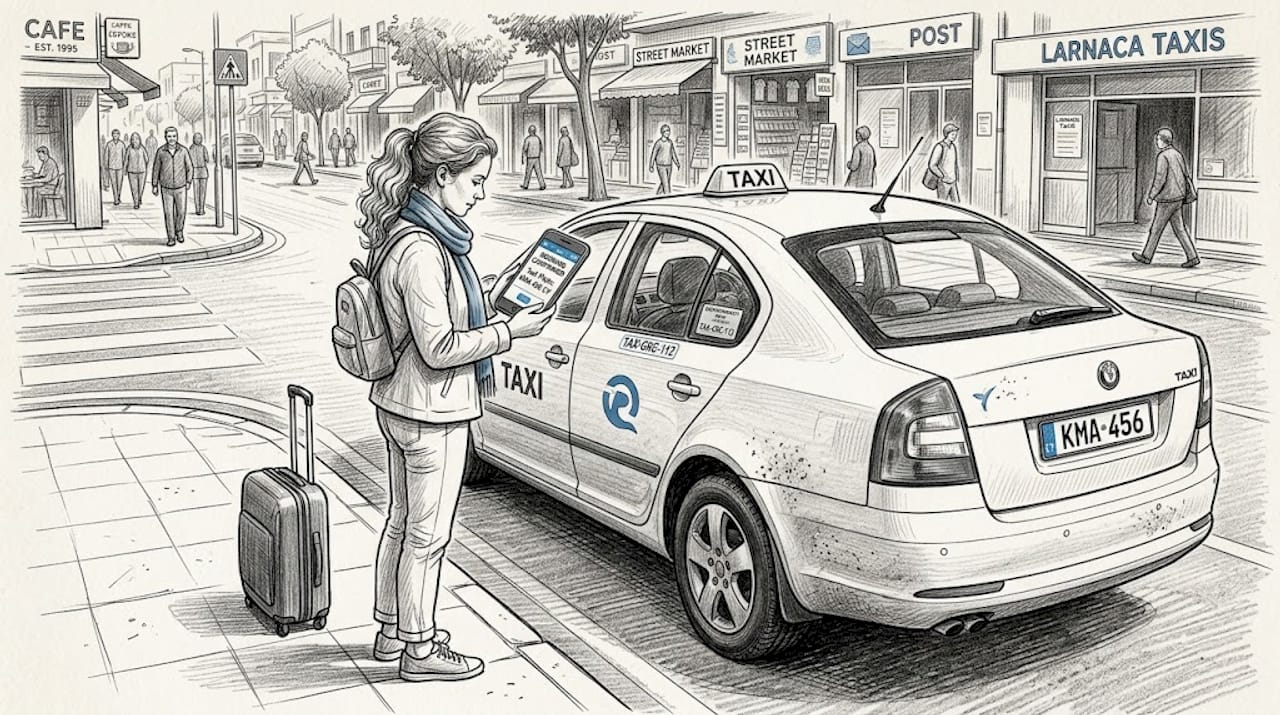
Step 3: Locate the official taxi ranks
If you are arriving at Larnaca Airport and have not pre-booked, head directly to the official taxi rank outside the arrivals terminal. Taxis here are authorised and subject to the licensing requirements overseen by the Road Transport Department. Do not accept offers from individuals approaching you inside the terminal building.
Step 4: Check for legal indicators before boarding
Every licensed taxi should display visible company branding, a functioning metre, and the driver’s printed identification inside the vehicle. Ask to see the licence if it is not immediately visible. A legitimate driver will not hesitate to show it.
Step 5: Save your booking details and share them
Before the car moves, send your booking confirmation, including the vehicle registration and driver’s name, to a trusted contact. This simple step takes thirty seconds and provides an important safety net.
Pro Tip: Understand the benefits of pre-booking taxis before your journey. Pre-arranged rides create an automatic paper trail that protects you and the driver, removes pricing ambiguity, and means you are never left waiting in an unfamiliar area.
| Indicator | What to look for | What to do if absent |
|---|---|---|
| Company branding | Logo on car, uniform or badge | Do not board, seek official rank |
| Metre | Visible, switched on at start | Request it is turned on, or leave |
| Driver ID | Photo ID displayed inside vehicle | Ask to see licence before boarding |
| Receipt availability | Offered or provided on request | Insist, or note company details |
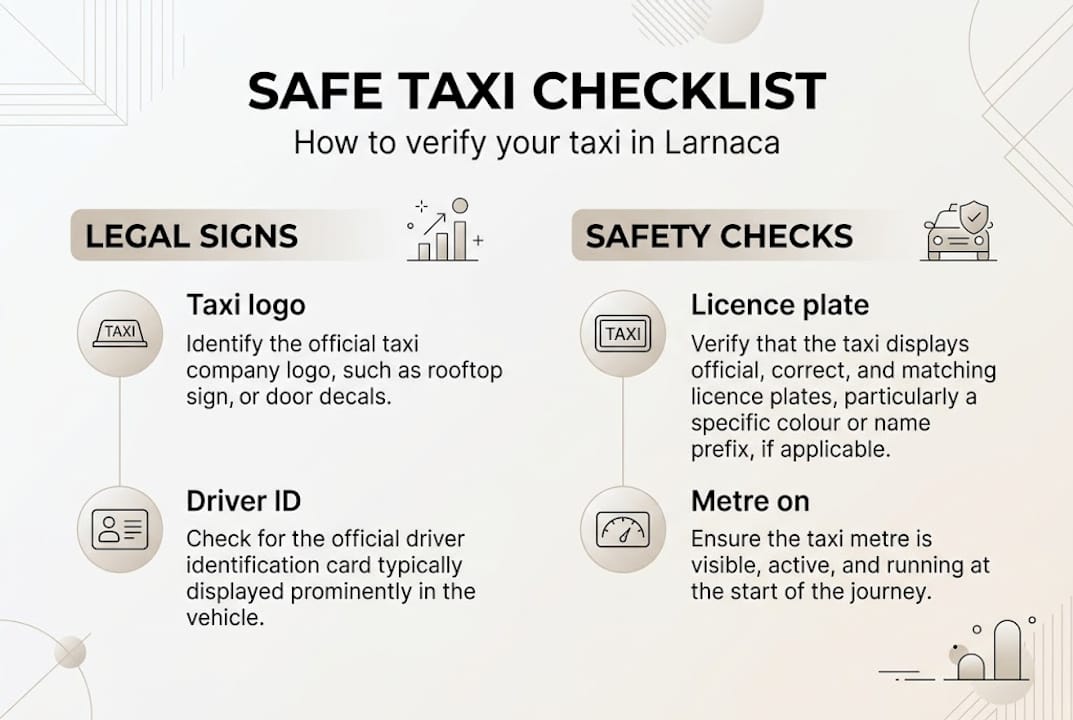
If a driver refuses to show identification, refuses to switch on the metre, or becomes aggressive when questioned, do not board the vehicle. Walk away, find the official rank, and report the incident to airport staff or police if necessary.
Ensuring your journey stays safe: On the road precautions
Booking a legitimate taxi does not mean your safety checks stop when you close the door. The journey itself requires a small degree of active attention, particularly if you are in an unfamiliar city.
As the taxi pulls up, compare the number plate with the one in your booking confirmation. Check that the vehicle make and colour match. If you are at an airport rank, confirm the driver knows your destination before you place luggage in the boot. These checks take under a minute and significantly reduce the likelihood of confusion or problems.
Inside the vehicle, look for the driver’s identification card, which should be displayed where passengers can see it. Confirm the metre is running. Sit in the rear seat where possible, and ensure your seatbelt is functioning and secure. If travelling with children, check that any agreed child seat is properly fitted before the journey begins.
“The 2026 digital licence verification platform being introduced in Cyprus will allow passengers to scan or search a driver’s registration and confirm their licence status in real time, representing a significant step forward in passenger safety.”
Do’s and don’ts during your taxi journey in Larnaca:
- Do confirm the metre is switched on as soon as you board
- Do keep your phone accessible throughout the journey
- Do track your route using a maps app so you can notice any unexpected diversions
- Do request a receipt at the end of the journey and keep it
- Don’t share sensitive personal or financial information with the driver
- Don’t leave bags in the boot if you feel uncertain about a stop
- Don’t pay large amounts of cash upfront before reaching your destination
- Don’t ignore your instincts: if something feels wrong, ask to stop in a public area
Modern vehicles from reputable operators offer modern taxi fleet safety features including GPS tracking and digital payment systems, both of which provide added security and accountability for every journey.
If you need to end a journey early due to feeling unsafe, ask the driver calmly to stop at the nearest public area such as a petrol station, hotel, or busy street. Once out of the vehicle, contact local authorities or your hotel to report the issue.
A local perspective: What most travellers get wrong about taxi safety in Larnaca
From our experience operating in Larnaca, the single biggest mistake tourists make is assuming that an empty taxi waiting outside their hotel or restaurant is legitimate simply because of its location. Pirate operators study tourist habits. They park near hotels, popular restaurants, and beach areas precisely because those are places where travellers feel relaxed and are less likely to ask hard questions.
The second most common misunderstanding involves pricing. Many travellers hear a low verbal quote from an unlicensed driver and assume they are getting a bargain. They often end up paying significantly more at the destination when the driver changes the agreed price, citing invented extras. A metered fare from a licensed operator is almost always fairer overall, and the receipt gives you grounds for a formal complaint if there is ever a dispute.
There is also a practical point about driver interaction. Asking polite, direct questions such as “May I see your licence?” or “Can you switch the metre on, please?” is entirely normal behaviour in Cyprus. Reputable drivers expect it and welcome it. A driver who reacts defensively or evasively to these questions is telling you something important. Trust that signal.
Always request a receipt at journey’s end. Keep it on your phone or in your bag. If there is ever a dispute about the fare or the journey, a receipt connected to a driver and vehicle provides clear evidence. You can find further detail on the local industry standards that apply to every legitimate operator in the region.
Reliable taxi options for your Larnaca journey
Knowing the risks and checks is valuable, but you also need to know where to turn for genuinely safe, vetted transport when you arrive.

For stress-free arrivals and departures, reliable Larnaca airport transfers offered by fully licensed, professionally managed services remove every risk discussed in this guide. A confirmed booking, a named driver, a modern and inspected vehicle, and a fixed transparent fare mean you can focus entirely on your trip rather than your transport. Whether you are a solo traveller, a couple, or a family needing a larger vehicle, exploring the vehicle options for airport transfers available in Larnaca ensures you travel in comfort, safety, and confidence from the moment you land.
Frequently asked questions
How can I spot an unlicensed taxi in Larnaca?
Unlicensed taxis typically lack visible company branding, do not display driver IDs inside the vehicle, and will not offer a metre or printed receipt. They often approach passengers directly rather than waiting at official ranks.
Is it safer to book a taxi in advance or hail one in Larnaca?
Pre-booking is significantly safer than hailing, particularly at night or when travelling with children, as it provides a verified driver, vehicle details, and a booking record.
Should I ask for a receipt after my taxi ride?
Yes, always request a receipt so that your journey is formally logged and can be referenced clearly if any dispute over the fare or the journey arises afterwards.
What if I feel unsafe during a taxi journey in Larnaca?
Ask the driver calmly to stop at the nearest busy public location, then exit and immediately contact local authorities or your accommodation for further assistance and to log the incident formally.