

How to optimise corporate taxi costs for Cyprus businesses

How to optimise corporate taxi costs for Cyprus businesses
TL;DR:
- Poor management of taxi spend can increase costs by over 40 percent.
- Effective policies and enforcement are crucial for sustainable taxi cost savings.
- Using technology and leadership support optimizes ground transport budgets.
Companies that fail to manage their travel and entertainment budgets carefully pay a steep price. Industries without managed travel programmes spend 40.3% more on T&E than those with enforced policies. For corporate travel managers in Cyprus, taxi costs are one of the most controllable yet frequently overlooked line items. Whether you are moving executives between Larnaca Airport and Nicosia or shuttling staff to client meetings, every unmanaged journey chips away at your bottom line. This guide walks you through a practical, step-by-step approach to benchmarking, optimising, and continuously improving your corporate taxi spend.
Table of Contents
- Defining corporate taxi requirements and benchmarking costs
- Prepping for cost optimisation: Essential tools and best practices
- Executing an optimisation strategy: Actionable steps for Cyprus businesses
- Reviewing results and continuous improvement
- The overlooked truth about taxi cost optimisation in Cyprus
- Unlock more savings with the right corporate taxi partner
- Frequently asked questions
Key Takeaways
| Point | Details |
|---|---|
| Enforcement matters | Companies with strong travel policy enforcement save significantly on taxi costs. |
| Digital tools boost efficiency | Booking and analytics platforms make monitoring and controlling spend much easier. |
| Continuous review pays off | Regularly auditing and adjusting corporate taxi arrangements leads to ongoing savings. |
| Tailored solutions work best | Optimising for specific Cyprus business needs delivers the highest ROI on taxi spend. |
Defining corporate taxi requirements and benchmarking costs
Before you can reduce spend, you need to understand exactly what you are spending and why. Most Cyprus travel managers are surprised when they map out all the scenarios where their company uses taxis. The list is longer than expected.
Common business situations requiring taxis include:
- Airport transfers for arriving and departing executives or clients
- Inter-city journeys, such as Larnaca to Nicosia or Limassol
- Client meeting transfers from hotels to offices or conference venues
- Corporate event logistics, including shuttles for delegates
- Employee welfare transport, such as late-night or early-morning shifts
Once you have mapped these scenarios, the next step is establishing a cost baseline. Understanding the key benefits of taxi services for each journey type helps you compare value, not just price.
| Journey type | Estimated cost range (EUR) | Typical use case |
|---|---|---|
| Larnaca Airport to city centre | €18 to €25 | Executive arrivals and departures |
| Larnaca to Nicosia | €55 to €75 | Inter-city business meetings |
| Hourly hire (in-city) | €30 to €45 per hour | Client entertainment, roadshows |
| Larnaca to Limassol | €65 to €85 | Regional office visits |
| Short in-city transfer | €8 to €15 | Hotel to venue, quick errands |
These figures give you a working benchmark. Any invoices consistently above these ranges warrant investigation. Checking them against taxi industry standards in Cyprus ensures you are comparing against a credible local reference.
Benchmarking also means looking at your own historical data. Pull three to six months of taxi receipts and invoices, then calculate your average cost per trip by journey type. This single action often reveals patterns: certain departments overspending, specific routes being misused, or peak periods driving avoidable surge charges.
The financial case for doing this properly is compelling. Ground transport enforcement impacts ROI by up to 62%, making it one of the highest-leverage areas in any corporate travel programme. Even a modest improvement in policy compliance translates directly to measurable savings and a stronger return on your overall travel investment.
Prepping for cost optimisation: Essential tools and best practices
With a clear picture of your requirements and costs, you can now build the infrastructure for genuine optimisation. The right tools make the difference between a policy that exists on paper and one that actually changes behaviour.
Here is what a well-equipped travel manager needs:
- A digital booking platform that consolidates all taxi requests through a single, trackable channel
- Spend analytics software that categorises journeys and flags anomalies automatically
- A mobile approval workflow so managers can authorise or query trips in real time
- A preferred provider agreement with a reliable local operator for negotiated rates
- A clear written travel policy that specifies approved journey types, spending limits, and booking procedures
The contrast between manual and tech-enabled management is stark:
| Management approach | Visibility | Error rate | Policy compliance | Time to audit |
|---|---|---|---|---|
| Manual (spreadsheets, paper receipts) | Low | High | Inconsistent | Days |
| Tech-enabled (digital booking, analytics) | High | Low | Consistent | Minutes |
The data is clear: managed programmes with high enforcement achieve up to 62% higher ROI compared to those with loose oversight. That is not a marginal gain. It is the kind of improvement that justifies investing time in setting up proper systems.
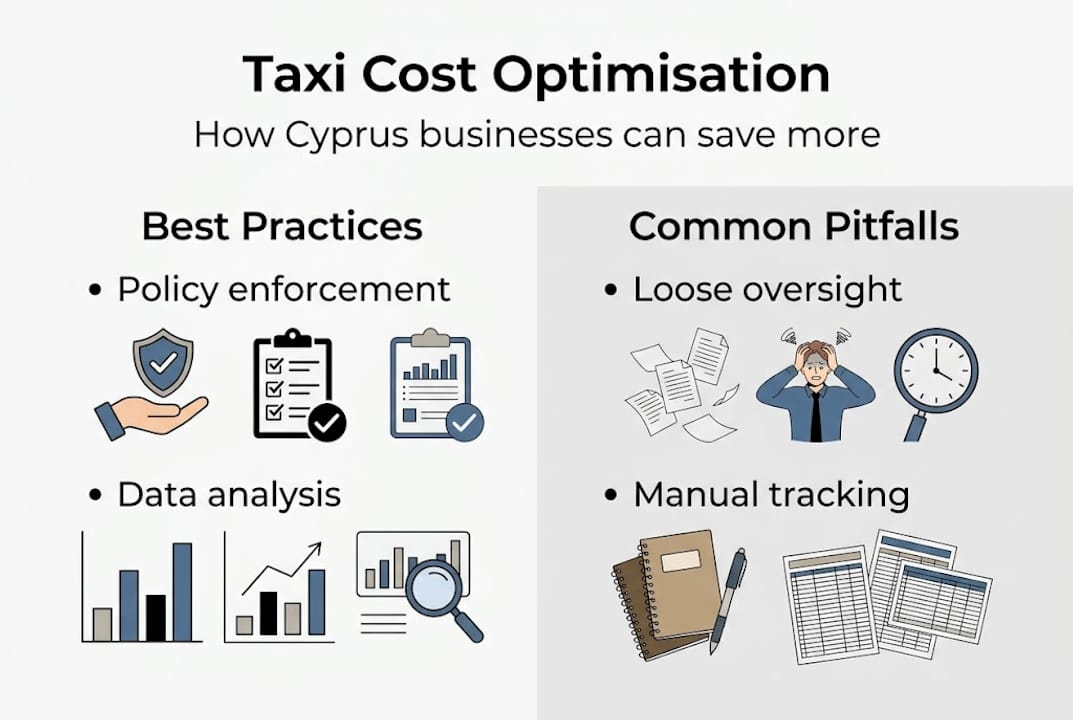
When booking taxi services in Larnaca, using a provider with a structured corporate account system gives you instant access to trip records, invoices, and usage reports. This removes the manual burden of chasing receipts from individual employees.
Best practices for enforcement and compliance include:
- Communicating the policy clearly at onboarding and during refresher sessions
- Setting spending thresholds that trigger automatic alerts
- Requiring pre-approval for journeys above a defined cost
- Reviewing exceptions monthly rather than ignoring them
The top taxi benefits of working with a professional provider extend beyond comfort. Structured invoicing, real-time tracking, and driver accountability all feed directly into your compliance framework. Providers using taxi technology innovations can share digital trip logs that integrate with your expense management system.
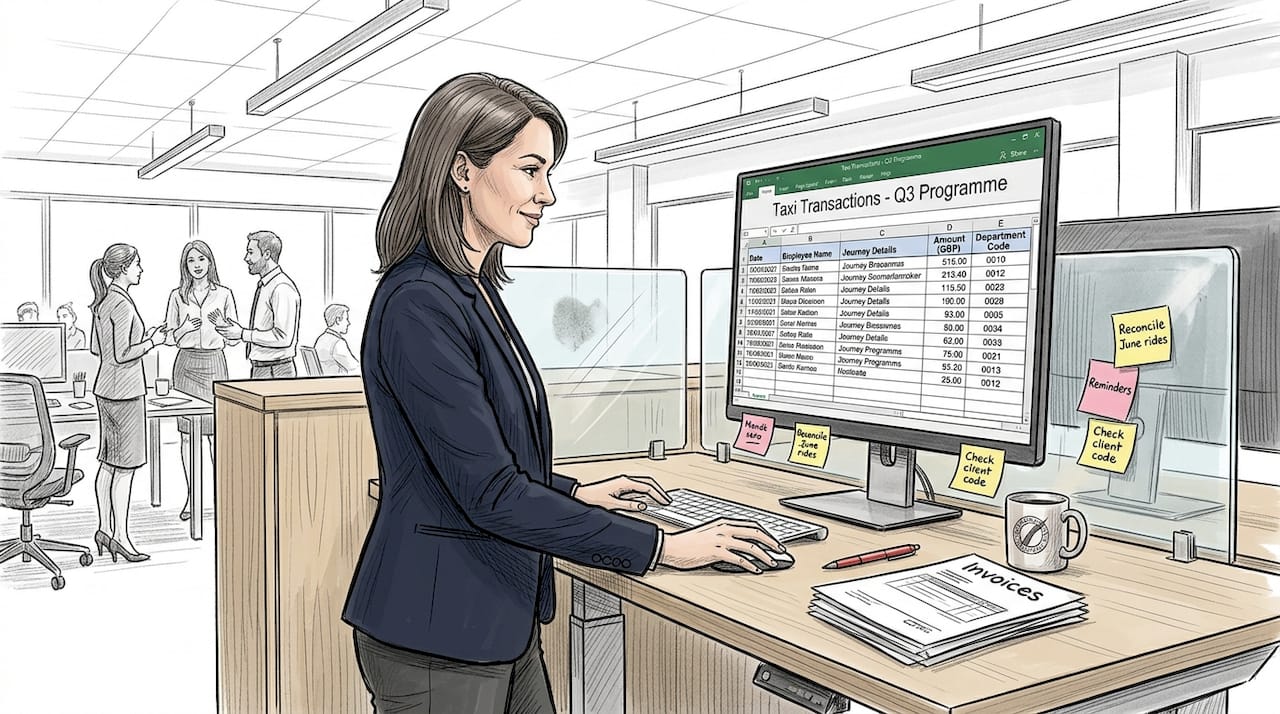
Pro Tip: Automate policy reminders within your booking platform. A simple prompt asking employees to confirm journey purpose before confirming a booking reduces unauthorised use by a significant margin and creates an audit trail without extra administrative effort.
Executing an optimisation strategy: Actionable steps for Cyprus businesses
Preparation sets the stage, but execution is where savings actually materialise. Here is a practical sequence for putting cost controls in place across your Cyprus operations.
- Negotiate a corporate rate agreement with one or two preferred taxi providers. Volume commitments in exchange for fixed rates remove price variability and make budgeting far more accurate.
- Publish an approved provider list so employees know exactly which companies to use. Unauthorised providers should require a written exception request.
- Introduce group ride policies for events or office locations where multiple employees travel the same route. Consolidating journeys cuts costs immediately.
- Set journey-type rules that match the appropriate vehicle to the trip. A solo employee travelling across town does not need an executive saloon booked for a client visit.
- Implement a monthly spend review using data from your booking platform and provider invoices.
The monthly checklist of data points to monitor should include:
- Total taxi spend versus budget
- Average cost per trip by journey type
- Number of out-of-policy bookings
- Trips booked outside approved providers
- Cancellation and no-show rates
- Spend by department or cost centre
For airport transfer solutions, pre-negotiated rates are especially valuable because airport journeys are frequent, predictable, and easy to benchmark. Understanding the difference between taxi and shuttle options also helps you select the most cost-effective solution for group arrivals.
Common pitfalls to avoid include policy drift, where rules are gradually ignored without consequence, and unauthorised usage, where employees book outside the approved system because it is more convenient. Both problems share the same root cause: a lack of consistent enforcement. Low enforcement leads to up to 40.3% higher ground transport spend, a figure that should motivate any travel manager to treat compliance as non-negotiable.
Pro Tip: Ask your preferred provider for a monthly analytics report highlighting outlier trips. Journeys that are significantly longer in distance or duration than the route average often indicate detours, waiting time abuse, or simple booking errors that are easy to correct once identified.
Reviewing results and continuous improvement
Executing a strategy without measuring its impact is guesswork. Regular auditing transforms your taxi programme from a one-time fix into a continuously improving system.
Start by establishing a core set of KPIs that you review every month:
| KPI | What it measures | Target benchmark |
|---|---|---|
| Cost per trip | Average spend per journey | Within 5% of negotiated rate |
| Policy compliance rate | % of trips booked via approved channels | Above 90% |
| Out-of-policy spend | Value of non-compliant bookings | Below 5% of total taxi spend |
| Cancellation rate | % of bookings cancelled or no-showed | Below 8% |
| Spend vs. budget variance | Actual vs. planned taxi expenditure | Within 10% |
When results lag behind targets, the following tactics typically restore performance:
- Reissuing the travel policy with a clear message from senior leadership
- Introducing a short-cycle approval process for trips above a threshold
- Running a brief training session for the highest-spending departments
- Renegotiating provider rates if market prices have shifted
- Reviewing whether the approved provider list still reflects the best available options in Cyprus
For corporate events, auditing post-event transport costs against pre-event estimates is a particularly effective way to identify where planning assumptions broke down.
“Companies that actively monitor and enforce travel policies consistently achieve measurable ROI improvements and eliminate unnecessary spend from their ground transport budgets.” 2025 GBTA x ASTA ROI Benchmarking Report
The audit cycle does not need to be complex. A monthly 30-minute review of your KPI dashboard, followed by one or two corrective actions, is enough to sustain progress. The key is consistency. Companies monitoring and enforcing policies saw measurable ROI and reduced unnecessary spend, confirming that the review process itself is a value-generating activity.
The overlooked truth about taxi cost optimisation in Cyprus
Most optimisation guides stop at tools and processes. That is where they fall short. In our experience working with corporate clients across Cyprus, the single biggest predictor of success is not the sophistication of the booking platform. It is whether senior leadership treats the travel policy as a real business priority.
When enforcement is delegated without accountability, policies erode quietly. Employees learn quickly that out-of-policy bookings are rarely questioned. Spend creeps upward. The travel manager carries the blame, but the real failure is cultural, not operational.
The companies that achieve lasting savings are those where executives visibly support the policy, where exceptions require a genuine justification, and where cost discipline is connected to broader business goals rather than treated as a back-office administrative task.
For corporate event taxi services in Cyprus, this mindset shift is especially visible. Events with strong executive sponsorship of transport logistics run to budget. Those without it rarely do. The lesson is straightforward: technology enables optimisation, but leadership sustains it.
Unlock more savings with the right corporate taxi partner
Putting the right processes in place is only half the equation. The other half is choosing a taxi partner in Cyprus who can actually support your programme with structured pricing, reliable service, and the reporting tools your team needs.

At Taxi in Larnaca, we work with corporate travel managers to deliver best taxi services for agencies and businesses that need predictable costs and professional service. From negotiated corporate accounts to detailed trip reporting, we make it straightforward to stay on budget. Explore the full benefits of taxi services we offer, or review our Larnaca airport transfer vehicles to find the right fit for your team. Get in touch today to discuss a tailored corporate arrangement.
Frequently asked questions
What are the main drivers of corporate taxi costs in Cyprus?
Key drivers include trip volume, journey type, provider selection, and the level of policy enforcement. Strict enforcement of ground transport policies is one of the most direct ways to reduce unnecessary spend.
How can travel managers track taxi usage and spending?
Use digital booking and analytics tools to monitor all journeys, spot excessive use, and ensure expenditure matches policy. Digital tools with enforced policies deliver up to 62% higher ROI compared to manual management approaches.
How often should taxi costs be reviewed for optimisation?
Review spend and compliance monthly, adjusting your strategy as company needs or market prices change. Regular measurement and enforcement drive repeatable, verifiable cost reduction over time.
What is a common mistake in corporate taxi cost control?
Failing to enforce travel policies and not auditing spend are the most frequent and costly missteps. Low enforcement leads to up to 40% higher spend, making consistent oversight essential for any Cyprus travel programme.