

Explaining taxi fares in Larnaca: Your guide to fair prices
Explaining taxi fares in Larnaca: Your guide to fair prices
You step off your flight at Larnaca Airport, tired and ready to reach your hotel, and the first taxi driver quotes you €200 for what should be a short transfer. Is that normal? Should you pay it? Reports of price gouging at Cyprus airports, with fares as high as €300 quoted for village transfers, show this confusion is far from rare. Whether you are a tourist arriving for the first time or a local resident who simply wants to stop overpaying, this guide breaks down exactly how Larnaca taxi fares work, what you should expect to pay, and how to protect yourself from being overcharged.
Table of Contents
- How are taxi fares calculated in Larnaca?
- Typical fare ranges and what affects the total price
- Watch out for price gouging: What to do and how to avoid it
- Tips for budgeting and getting the best value
- Book with confidence: Trusted taxi services in Larnaca
- Frequently asked questions
Key Takeaways
| Point | Details |
|---|---|
| Understand the fare formula | Taxi costs are calculated from base, distance, time, and surcharges so knowing these helps you budget wisely. |
| Factor in night and holiday costs | Fares rise noticeably during late hours and holidays, so always check rates in advance. |
| Be alert for overcharging | Stick to official ranks and confirm fare details to avoid any potential price gouging. |
| Improve your budgeting | Plan with fare estimates, pre-booking, and receipts for the best-value taxi experience. |
| Use trusted services | Opt for established taxi firms for transparent pricing and a hassle-free journey. |
How are taxi fares calculated in Larnaca?
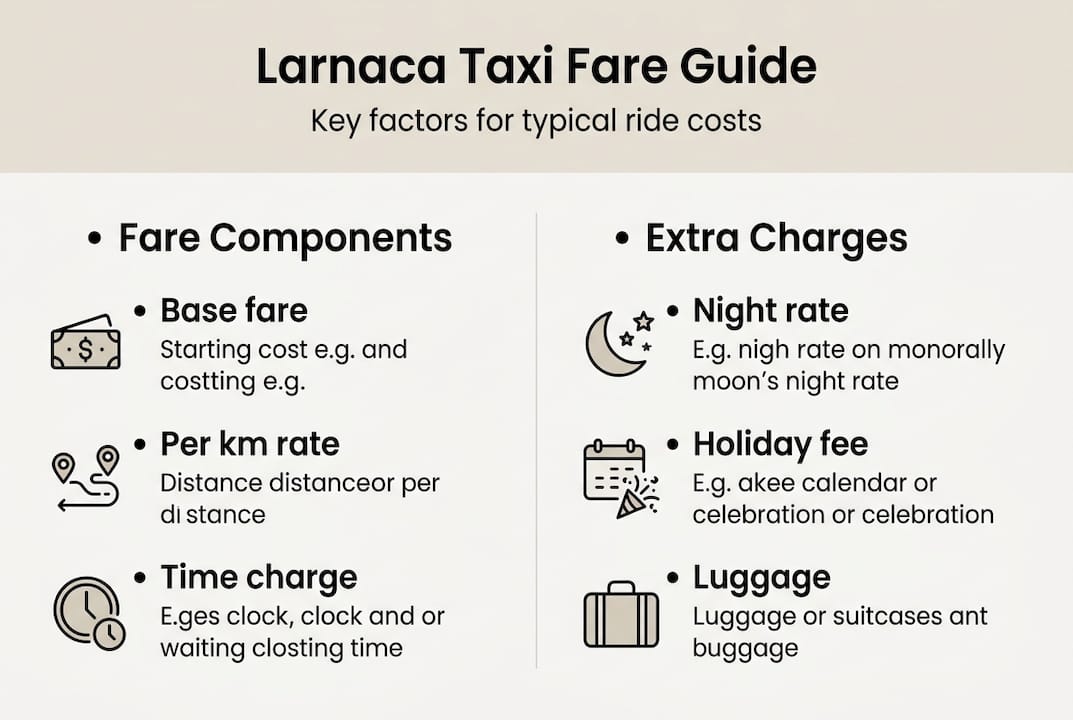
Understanding the fare formula is the single most useful thing you can do before stepping into a taxi. In Larnaca, as in most regulated taxi markets, the fare formula includes a base fee, a per-kilometre rate, waiting time charges, and applicable surcharges. Each component adds to the total, and knowing what each one means puts you firmly in control.
Here is how a typical fare is built up, step by step:
- Base fare — A fixed starting charge applied the moment you enter the taxi, regardless of distance.
- Per-kilometre rate — A rate charged for every kilometre travelled. Day and night rates differ.
- Waiting time — If the driver waits at traffic lights, for you to load luggage, or at a stop, a per-minute charge applies.
- Surcharges — These cover airport pickups, public holidays, late-night travel, and sometimes large luggage.
- Fixed fares — Some routes, particularly airport transfers, may be offered at a flat rate agreed before departure.
The table below gives you a practical snapshot of what to expect across common journey types in Larnaca:
| Journey type | Daytime estimate | Night/holiday estimate |
|---|---|---|
| City centre to city centre | €5–€10 | €8–€15 |
| Larnaca Airport to city centre | €15–€25 | €25–€40 |
| City centre to nearby village | €20–€35 | €35–€55 |
| Airport to distant village | €40–€70 | €60–€100+ |
These are estimates based on regulated structures and typical journey lengths. Actual fares may vary slightly depending on traffic and route.
Pro Tip: Before the driver starts the metre, ask clearly whether the fare is metered or fixed. For airport transfers especially, a pre-agreed fixed fare often works out cheaper and removes any ambiguity about the final bill. You can also review Larnaca taxi industry standards to understand what regulated operators are expected to follow.
Typical fare ranges and what affects the total price
Now that the formula is clear, let us look at what prices to expect in real situations, and the factors that legitimately push fares up or down.
Several variables influence what you will pay on any given journey:
- Route length — Longer distances naturally cost more. A trip from the airport to a remote village will always cost significantly more than a short city hop.
- Time of day — Night rates typically apply from around 20:30 to 06:00. Expect a noticeable jump in cost during these hours.
- Day of the week and public holidays — Weekend and public holiday surcharges are standard across Cyprus.
- Waiting time — If you ask the driver to wait while you visit a shop or attraction, the metre keeps running.
- Luggage and special requests — Oversized luggage, child seats, or additional stops may attract extra charges.
- Number of passengers — Most standard taxis carry up to four passengers at no extra cost, but larger groups may need a different vehicle.
The sharpest price jump occurs at night and on public holidays. Late-night and holiday surcharges can make fares considerably higher than the daytime equivalent, sometimes by 30 to 50 per cent. A journey that costs €20 in the afternoon could easily reach €30 or more after 20:30.
For airport journeys specifically, it is worth checking typical airport taxi fares before you travel so you arrive with a realistic figure in mind. You can also find useful airport taxi information covering what to expect when you land.
Short city trips have a different cost profile from long transfers. A five-minute city ride is dominated by the base fare, meaning the per-kilometre element barely registers. A 40-minute airport-to-village run, by contrast, is almost entirely distance-driven, with surcharges layered on top. Knowing this helps you judge whether a quoted price is reasonable before you agree to it.
Watch out for price gouging: What to do and how to avoid it
Understanding standard fares leads to informed choices, but extreme cases still occur. Here is how to protect yourself.
Price gouging means being charged a fare that is wildly above the regulated rate, with no legitimate justification. It is different from a legitimate night surcharge or an airport pickup fee. The clearest sign is a driver quoting a fixed price that bears no relation to the actual distance or regulated structure.
“A taxi driver at Larnaca Airport quoted €300 for a village transfer. After negotiation, the fare was reduced to €200. Official taxi ranks are considered the safest option to avoid such situations.”
Follow these steps to protect yourself from overcharging:
- Use official taxi ranks — Taxis at official ranks are more likely to follow regulated pricing. Avoid accepting rides from drivers who approach you inside the terminal.
- Check for signage — Licensed taxis in Cyprus display their licence and fare information. Look for it before you get in.
- Clarify the fare upfront — Ask whether the fare is metered or fixed, and confirm the approximate total before the journey begins.
- Keep your receipt — Always ask for a receipt. It records the fare, the driver’s details, and the route, which is essential if you need to raise a complaint.
- Pre-book where possible — Booking reliable taxi services in advance locks in a price and removes the risk of on-the-spot overcharging.
Pro Tip: If a driver quotes more than €100 for a short city fare or a standard village transfer, politely decline and approach another taxi at the official rank. A firm but courteous refusal is always your right as a passenger.
Tips for budgeting and getting the best value
Preventing overcharging lets you travel with confidence. Now here is how to consistently get the best value and stay within your budget across every journey.
- Pre-book and get a quote — Contacting a taxi service before your trip lets you confirm the fare in writing. No surprises, no negotiation at the kerb.
- Share the ride — If you are travelling with others, splitting a taxi is almost always cheaper per person than using public transport for groups of three or more.
- Confirm the price before you move — Even with metered taxis, ask for an estimate. Drivers familiar with the route can usually give you a reliable figure.
- Keep receipts for every journey — This is especially useful on business trips or if you need to dispute a charge later.
- Use taxi apps or pre-booking platforms — These often display fare estimates upfront and provide a digital record of your journey.
- Combine journeys — If you need to visit multiple locations, plan them in a logical sequence. A single longer journey is usually cheaper than two separate short ones.
Regulated fare structures usually offer genuine value, but opportunistic overcharging is reported at airports, so preparation is your best defence.
Pro Tip: Ask your hotel or accommodation host what a typical fare should be for your planned routes. Local knowledge is often the most accurate guide, and it gives you a confident benchmark when speaking to drivers.
For airport journeys, reviewing taxi info for airport trips before you land is a smart move. If you are heading into town, checking taxi to Larnaca Town gives you a clear picture of what to budget.
Book with confidence: Trusted taxi services in Larnaca
With your fare knowledge in hand, the next step is choosing a provider that takes the guesswork out of pricing entirely. Pre-booking with an established local taxi service means your fare is agreed before the journey starts, your driver is vetted and professional, and there are no unpleasant surprises when you arrive at your destination.

At Taxi in Larnaca, we operate with full transparency on pricing, a modern fleet, and experienced drivers who know the island well. Whether you need to arrange an airport transfer for a smooth arrival, organise group airport transfers for a larger party, or explore the full range of airport taxi options available across Larnaca, we make it straightforward. Booking in advance is the single most effective way to guarantee a fair, regulated fare and a stress-free journey from the moment you land.
Frequently asked questions
Are taxi fares in Larnaca fixed or do they vary?
Taxi fares in Larnaca are metered with regulated rates, but the total varies based on distance, time of day, and applicable surcharges. Night and holiday fares are consistently higher than standard daytime rates.
How can I avoid being overcharged by a taxi in Larnaca?
Use official taxi ranks, confirm the fare before the journey begins, and always request a receipt. Official ranks are safest and significantly reduce the risk of encountering opportunistic pricing.
What is a typical fare from Larnaca Airport to the city centre?
A standard daytime fare ranges from €15 to €25. Night travel, luggage surcharges, or public holidays can push this higher. Regulated surcharges may apply depending on your specific circumstances.
Is there a difference in fares between city, airport, and village destinations?
Yes. Village and airport transfers cost more due to distance, and night or holiday pricing adds a further layer on top of the base fare for any destination.
Is tipping taxi drivers expected in Larnaca?
Tipping is not required, but rounding up to the nearest euro is a common and appreciated gesture for good service.